

Public Health and Emergency Management Task Force
The Public Health and Emergency Management Task Force has organizational jurisdiction over a broad range of issues including Disaster and Emergency Public Health Response, Homeland Security, Cybersecurity, Healthcare, Human Services, Nutrition, and Immigration.
Federal Priorities
- Ensure Governors are consulted, and their gubernatorial authorities are maintained, in the areas of defense, homeland security, emergency management, health, and human services, including those outlined in U.S.C. Title 10 and 32 pertaining to National Guard readiness and structure;
- Advocate for flexibility and support for a robust health and human service system including safety net programs, such as Medicaid and SNAP, and oppose shifting essential federal funding obligations to states and territories without adequate planning;
- Ensure the National Guard is equipped with sufficient resources and capabilities to fully recruit and man a force ready to support domestic emergencies and fulfill its role as the operational reserve for national security missions;
- Enhance emergency response and disaster recovery by ensuring federal programs, such as Disaster Relief Fund, National Flood Insurance, and Community Development Block Grant Disaster Recovery, are sufficient, adaptable, and streamlined to meet the diverse needs of states and territories, and easier to navigate for individuals, businesses, and all levels of governments;
- Strengthen preparedness efforts by fostering both inter-state and federal-state collaborations to maintain resilient supply chains and stockpiles for critical infrastructure before, during, and after emergencies;
- Support federal initiatives that provide tools and flexibility to states and territories to ensure safe communities for all Americans in areas such as malicious unmanned aircraft systems, cyberattacks, border security, trafficking, substance use disorder, justice-involved re-integration, crisis response systems, and comprehensive safety measures.
Advocating for State and Local SNAP Recommendations
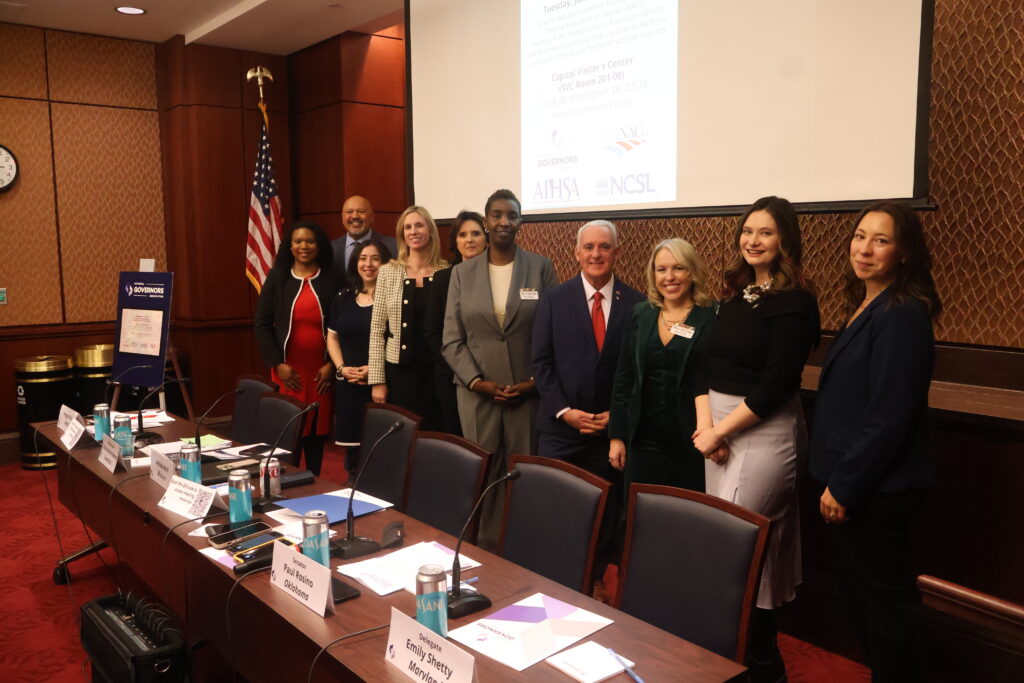
On January 13, a coalition of state and local leaders, led by NGA, urged Congress to act swiftly on an urgent issue within the Supplemental Nutrition Assistance Program (SNAP) that was exacerbated by the recent federal shutdown. At a congressional briefing, organizations including NGA, the National Association of Counties, the American Public Human Services Association and the National Conference of State Legislatures, warned that new cost-sharing requirements under H.R. 1 could significantly increase state SNAP expenditures if Payment Error Rate data collected during the shutdown is not excluded. Ahead of the briefing, NGA also released this commentary regarding strategic solutions Governors implemented when SNAP was held up due to the partial government shutdown. The coalition’s letter to congressional leadership calls for two fixes in a January Continuing Resolution: delaying cost-sharing implementation until FY2030 and excluding shutdown months from FY2026 PER calculations.
Task Force
Governor Mike Kehoe, Missouri – Co-Chair
Governor Josh Stein, North Carolina – Co-Chair
- Governor Katie Hobbs, Arizona
- Governor Gavin Newsom, California
- Governor Ned Lamont, Connecticut
- Governor Leon Guerrero, Guam
- Governor Josh Green, Hawai’i
- Governor Kim Reynolds, Iowa
- Governor Jeff Landry, Louisiana
- Governor Michelle Lujan Grisham, New Mexico
- Governor Kathy Hochul, New York
- Governor Bill Lee, Tennessee
- Governor Spencer Cox, Utah
- Governor Phil Scott, Vermont