
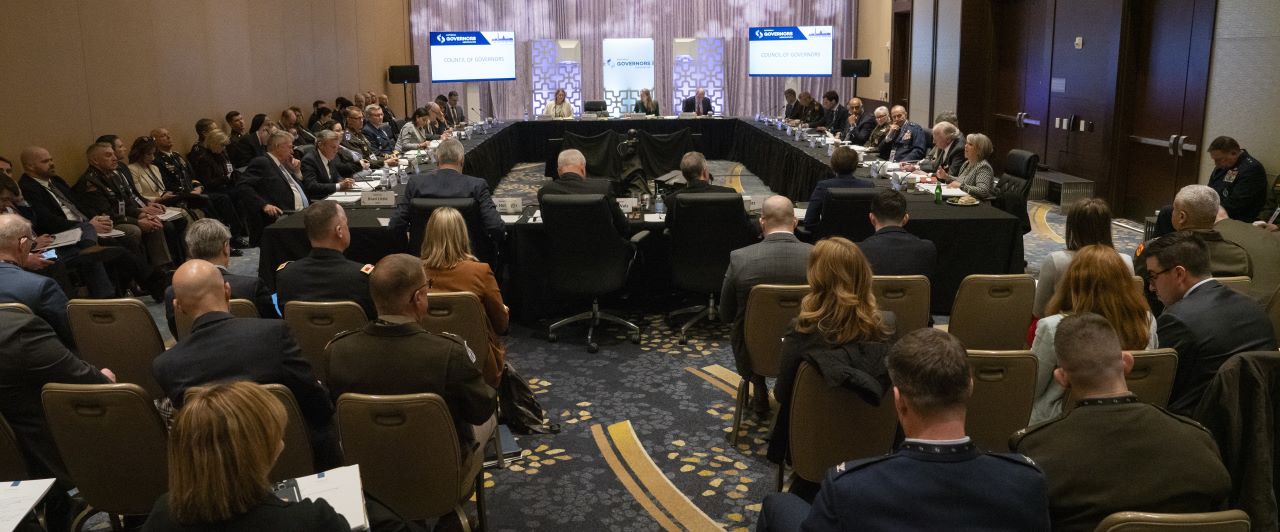
Council of Governors
Workforce Work Group
The Workforce Work Group collaborates with the Department of Defense to improve recruitment and retention of a dedicated workforce and the talent required to support global missions by exploring policies that support current and prospective servicemembers and their families, especially within the National Guard.
In 2021, Governors Gretchen Whitmer of Michigan and Spencer Cox of Utah determined that a more focused effort was needed within the Council of Governors to address recruitment and retention challenges, especially within the National Guard. Seeking to ensure the National Guard remains competitive with the fast-moving private sector, the Council created the Workforce Work Group to explore policies and practices that improve recruitment and retention and strengthen the military workforce. Now led by Michigan Governor Gretchen Whitmer and South Carolina Governor Henry McMaster, the Workforce Work Group has three current focus areas: recruitment, childcare, and healthcare.
In November 2023, the Workforce Work Group surveyed states to collect information on National Guard workforce challenges and best practices. Partnering with the National Governors Association to review the survey and carry out additional research, the Workforce Work Group offers on this site a selection of best practices that aim to address these challenges. The goal of the site is twofold: for states and territories to learn from one another’s work, and for everyone to better understand what states and territories are doing to creatively lean into recruitment and retention challenges within the National Guard.
Priorities
• Recruitment
• Childcare
• Healthcare

The Council of Governors (Council) was established in 2008 to improve and maximize partnership between the federal government and the states on matters pertaining to the National Guard, homeland defense, and civil support activities. The Council consists of ten Governors (five from each party) appointed to two-year terms by the President who work with a number of federal participants including the Secretaries of Defense and Homeland Security, the President’s Homeland Security and Counterterrorism Advisor, the Commander of U.S. Northern Command, and the Chief of the National Guard Bureau, among others. Currently, the Council has four working groups to focus and make progress on the priorities of the Council: Cybersecurity, Emergency Management and Disaster Response, Military Matters, and Workforce.
Work Group Priorities
Click on a priority to see State and Territory examples. Items highlighted in light purple indicate programs that are also open to active-duty service members.
Service members in the National Guard play a vital role in states and territories. Recruiting individuals who are committed to serving their communities and arming them with the skills and training they need is key to maintaining a strong National Guard workforce. Governors, working with their State’s Adjutant General, and in some instances their state legislature and the Department of Defense, continue to make strides in helping to recruit and educate skilled Guards members. Look up benefits by state/territory here.
Financial Incentives:
Many states offer bonuses for National Guard members who provide referrals that lead to new enlistments and/or commissions, often called Joint Enlistment Enhancement Programs. These bonuses generally range from $500 to $1000 depending on the state. Additionally, some states have instituted other financial incentives such as legislation exempting military pay from state income tax, enlistment/re-enlistment bonuses, and state retirement pay. Some examples are highlighted below:
Joint Enlistment Enhancement Programs
- Alabama – Governor Kay Ivy signed Executive Order 723 establishing the Alabama National Guard Joint Enlistment Enhancement Program (JEEP) offering compensation of up to $500 for each new or prior service recruit that current members of the Alabama National Guard in the pay grade of E-1 to O-3 brings to the Alabama National Guard. In 2025, Governor Ivey signed Executive Order 740 to revitalize the program.
- Arkansas – The Arkansas National Guard established its JEEP which compensates current Arkansas National Guard soldiers, airmen, or veterans who provide referrals that result in an enlistment $1,000 per new or prior service lead.
- Colorado – Governor Jared Polis and Colorado Adjutant General Laura Clellan established the Joint Enlistment Enhancement Program (JEEP). This program incentivizes current Colorado National Guard members to take an active part in recruitment of new members, providing the servicemember with $1000 when someone they refer enlists and begins Initial Entry Training.
- Connecticut – Governor Ned Lamont launched a recruitment initiative for the Connecticut National Guard. The Joint Enlistment Enhancement Program (JEEP) provides current and retired members of the Connecticut National Guard with the financial incentive of up to $1500 per qualified lead that results in enlistment or commission.
- Florida – The Florida National Guard’s Joint Enlistment Enhancement Program offers current members within certain pay grades (O-3 and below) as well as retirees who refer leads that lead to an enlistment $1,000.
- Idaho – The Idaho National Guard offers a Guard Recruitment Assistant Sponsorship Program which provides $1,000 to Idaho Guard members who provide referrals – $500 upon enlistment and $500 upon shipping to basic training.
- Indiana – In 2025, Governor Mike Braun introduced a partnership with the Indiana National Guard as part of a broader initiative to help students lay out a path for their future. Students in Indiana will be able to earn an Enlistment & Service Readiness Seal for their high school diplomas by completing requirements including taking an Introduction to Public Service Class or one year of JROTC, achieving a certain ASVAB score, and finishing all three components of the Career Exploration Program, among others.
- Kentucky – The Kentucky National Guard’s Kentucky Enlistment Enhancement Program pays $500 to Kentucky Guard Soldiers and Airmen who provide leads that result in enlistment.
- Minnesota – Governor Walz signed a bill into law in May 2024 which included a section that allows the Minnesota National Guard to establish a “Referral Bonus Program” that would provide bonuses based on successful referrals related to “enlistment in or commissioning into the Minnesota National Guard” if needed for recruitment efforts. Bonuses would be paid for with funds that have already been appropriated.
- Montana –Montana has the Guard Referral Incentive Program which pays $1000 to service members and veterans who make a referral that results in an enlistment.
- Oklahoma – The Guard Recruiting Incentive Program offers $500 to current soldiers, airmen, and retirees who provide a lead that results in an enlistment.
- Oregon – The Enlistment Enhancement Program incentivizes current soldiers and retirees who can provide a significant lead to recruiters with a $1,000 reward.
- Virginia – The Virginia National Guard’s Referral Enlistment Program offers a monetary incentive of no less than $1,000 paid in up to two installments (one on enlistment, one on completion of training) to Virginia citizens who provide quality leads.
- Washington – In 2025, Governor Bob Ferguson signed SB5545, which modified provisions regarding family home providers overseen and certified by federal military service, increasing the amount of childcare providers available to Guard members.
- Wyoming – The Wyoming National Guard referral system gifts guardsmen $500 if they make a successful referral.
Other Financial Incentives
- Florida – A law passed in 2012 provides retirement pay from the state for persons 62 years of age or older who have completed 30 years of service in the Florida National Guard.
- North Dakota – In 2023, legislation was passed exempting military retirement pay from state income tax. More recently, the Governor signed legislation exempting military pay from state income tax.
- Pennsylvania – The Pennsylvania Air National Guard began offering triple the amount of a bonus for enlisting or re-enlisting. Bonuses depend on the job you take. To deter competition within programs, bonuses do not apply to guardsmen who have received a bonus with a different National Guard or reserve component.
Community Engagement:
States have also tried to aid recruitment by increasing National Guard engagement in specific communities. The method of engagement varies depending on the state and the communities they target, but the aim is to embed the National Guard into those communities and strengthen ties between the people and the Guard. Additionally, recruiters have been conducting more outreach to schools to regain the access and rebuild relationships that may have been more limited during the pandemic response.
- Alabama – In FY2023, the Alabama Army National Guard saw a spike in enlistments. The Alabama Army National Guard credited its increase in recruitment to employing eight recruitment teams focusing on a different set of counties and building a community.
- Alaska—Following Typhoon Merbok, in an effort to strengthen ties with rural Alaskan communities, the Alaska National Guard partnered with the tribal consortium to recruit members in communities along the Yukon–Kuskokwim Delta area through the tribal job centers.
- Indiana – In 2025, Governor Mike Braun introduced a partnership with the Indiana National Guard as part of a broader initiative to help students lay out a path for their future. Students in Indiana will be able to earn an Enlistment & Service Readiness Seal for their high school diplomas by completing requirements including taking an Introduction to Public Service Class or one year of JROTC, achieving a certain ASVAB score, and finishing all three components of the Career Exploration Program, among others.
- Kansas – In Kansas, recruiters increased efforts to get into the community and attend community and recruitment events talking about the job skills, training and education individuals receive when joining the National Guard. The Guard has worked to embed itself in the community to bring awareness to potential recruits, employers, and civic leaders.
- Maryland – The Maryland National Guard and Salisbury University partnered together in May 2024 to establish a pipeline for Guard involvement on campus and share recruitment initiatives. The partnership opens doors for over 130 career paths, including opportunities in the STEM fields.
- Michigan – To get out the word about the National Guard and the benefits of joining, the Michigan Army National Guard worked with college athletes from the University of Michigan football program in a new recruitment campaign in 2022.
- Mississippi – The Mississippi Army National Guard Recruiting and Retention Battalion brought together prospective recruits they met at universities to a Recruitment Sustainment Program drill to observe the process of preparing for Basic Combat Training, begin to learn military terminology and protocols, and ask questions to current recruits and soldiers.
- Vermont – The Partnered Recruiting Initiative for Military and Employers Program is a partnership between the Vermont National Guard and businesses across the state and region to assist Guard members and their families with finding adequate full-time employment.
Education/Tuition Assistance:
One of the major incentives that the military offers is education and tuition assistance. All 50 states,the District of Columbia, and some territories offer state-level tuition assistance to National Guard members attending eligible in-state colleges and universities in addition to federal tuition assistance. There are also states that have non-financial educational support such as providing for early registration or converting military training into course credit. Some states extend educational incentives to spouses and dependents as well.
Tuition Assistance Programs – The specifics of state tuition assistance programs vary in terms of financial amounts and whether the money can be used solely for tuition or if it can be used for other fees.
Other Education Incentives
- Arizona – Troops to Educators (TTE) is Arizona’s version of the federal Troops to Teachers (TTT) program that ended in 2020. While the National Defense Authorization Act of 2022 re-established TTT, there was no funding allocated. In Arizona, TTE is a free service to help active-duty soldiers, spouses, veterans, and reservists navigate the certification process to begin a new career in education from kindergarten to grade 12.
- Florida – The Florida Department of Education works with Florida Colleges to implement Credit or Clock Hour for Military Experience Equivalency List, which guarantees military service members and veterans receive uniform postsecondary college credit or clock hours based upon the military courses and training they have completed.
- Guam – The GED+ Program is a joint venture between the Guam Army National Guard and the Guam Community College that enables students to attain a GED, pass the military entrance exam, and enlist in the Guard.
- Kentucky – In 2023, the Kentucky National Guard and Northern Kentucky University signed a memorandum of understanding to help their students who are National Guard members to balance their unique responsibilities and needs.
- Michigan – In 2023, Governor Whitmer signed legislation expanding the state tuition assistance program eligibility for spouses and dependents, increasing the funding cap from $10 million to $15 million. Michigan passed a law in 2025 that requires the remaining balance of the Michigan National Guard Tuition Assistance Fund at the end of the fiscal year to be transferred to the Michigan National Guard Benefit Fund to help Michigan National Guard members afford childcare, healthcare, and tuition.
- Pennsylvania – The Military Family Education Program (MFEP) provides lower cost educational opportunities to National Guard members’ spouses and/or children. Five academic years of higher education benefits are made available if the National Guard member commits to six additional years of service. This benefit can be assigned entirely to one dependent or split among multiple dependents.
- Washington – Washington passed a law in 2024 that enables National Guard members the ability to register for courses early at colleges and universities, giving them priority in course selection thus the ability to complete their degree while fulfilling their Guard responsibilities.
Other Recruitment Efforts:
- Colorado – The Colorado National Guard entered into a Memorandum of Understanding with Serve Colorado in 2023 which established expanded recruitment channels and increased awareness of career pathways and opportunities for interested individuals. Serve Colorado also plans to launch a pilot program in 2025 for an all-Guard wildfire mitigation crew in its Climate Corps.
- Washington – Members of the Washington National Guard can get free annual big game and small game hunting licenses.
Childcare is a top priority for Governors. Many Governors have worked to expand access and affordability for everyone who needs it. Due to requirements for the National Guard, which take Guards members away from home outside of standard business hours, some Governors have also worked to implement specific programs to aid in access and accessibility for National Guard families. In addition, some states have taken significant steps to reduce childcare costs for families, including for those who serve in the National Guard, such as New Mexico, which recently announced the expansion of free childcare to qualifying families earning up to 400% of the federal poverty level. Some examples of state programs that target support for National Guard families is provide below:
Simplifying the Regulatory Environment for Childcare Providers
Several states have taken steps to reduce the regulatory burden on childcare providers by eliminating the requirement of childcare providers to maintain a state license if they are already licensed by an armed forces branch or the U.S. Coast Guard. Below are examples of some of the states who have taken this step.
- Montana – In 2023, Governor Greg Gianforte signed HB 336, which eliminated the requirement for a state license for childcare providers or facilities if they are licensed by an armed forces branch (including the U.S. Coast Guard).
- North Dakota – In 2023, North Dakota passed SB 2182 which allows child care providers licensed by the Department of Defense to operate in North Dakota with their DOD license and without redundantly being licensed in the state.
- Oklahoma – In 2022, Governor Kevin Stitt signed SB 1286 which exempts childcare facilities certified by a branch of the Department of Defense or the U.S. Coast Guard from requirements of the Oklahoma Child Care Facilities Licensing Act. This allows for greater access to more childcare providers via certification and resources from the Department of Defense.
- Washington – In 2025, Governor Bob Ferguson signed SB5545, which modified provisions regarding family home providers overseen and certified by federal military service, increasing the amount of childcare providers available to Guard members.
Comprehensive Assistance Programs
States have also looked holistically in how they support Guard members and their families. This includes resources to support academic, emotional, and social support through a variety of programs that incorporate childcare. Below are a few examples of programs that states have implemented to provide these wraparound services in conjunction with childcare.
- Michigan – In 2025, Governor Whitmer signed the Michigan National Guard Child Care Assistance Act which created the Michigan National Guard Child Care Assistance Program. This program will provide stipends for eligible members to help cover child care costs for up to 12 hours a day for weekend drills and annual training, up to 39 days each year.
- New Jersey – The New Jersey National Guard Child & Youth Program offers a number of support services to National Guard youth. This includes youth camp, childcare support, educational and extracurricular grant resources, etc.
- New York – The New York National Guard Child and Youth Program (NYNGCYP) provides military children/youth with social, emotional, and academic support and resources for facing challenges associated with being a military family.
- Rhode Island – The RING Family Assistance Centers provide a variety services to Rhode Island National Guard families. This includes child and youth programs, access to support services, financial readiness and more.
Military Child Care in Your Neighborhood Program
Recently, 16 states have partnered with the Department of Defense to establish the Military Child Care in Your Neighborhood-PLUS (MCCYN-PLUS) Program. These fee assistance programs help keep childcare affordable for eligible families, while also seeking to ensure providers are on a path of continuous quality improvement. Below are a few examples of the many states who have taken action collaboratively with the Department of Defense to make childcare more affordable.
- Michigan – In November 2023, Michigan announced the implementation of the MCCYN-PLUS Program in their jurisdiction, which allows childcare providers 3 stars or higher to participate.
- Minnesota – In January 2024, Governor Walz and Lieutenant Governor Flanagan to announce the launch of MCCYN-PLUS which will help to reduce the cost of childcare expenses up to $1,800 per month per child.
- South Carolina – In August 2024, South Carolina announced the launch of MCCYN-PLUS in their jurisdiction to offer child care fee assistance to eligible military and Department of Defense civilian families when child care is unavailable on an installation or when families do not live close to an installation, giving families a sense of ease when searching for high-quality childcare.
Drill Weekend Support
States have made resources available to Guard members to help support childcare, among other costs, during drill weekends. Below are a couple of examples of states who have taken this additional step.
- Weekend Drill Child Care Program – Oregon, and 20 other states have established a pilot Weekend Drill Child Care (WDCC). This program aims to provide childcare to qualifying Army National Guard members during weekend drills.
- Wyoming – The Wyoming Military Assistance Trust Fund provides financial support to National Guard members and their dependents with expenses incurred during drill periods. One form of this assistance is reimbursement of childcare costs that occur during these periods.
Ensuring access to healthcare for National Guard members is a priority for the Council of Governors, this includes supporting efforts to expand access to federal health insurance programs to cover all members of the National Guard who need it. States have also developed and expanded programs to support holistic health and mental health programs for members of their state’s National Guard. Some of these programs have been driven by initiatives at the national level, but each state has taken those initiatives and molded them to meet the needs and circumstances of their Guard members.
Healthcare Access
- Connecticut – Per Connecticut General Statute Section 17a-453d, the state’s Department of Mental Health and Addiction Services is tasked with providing behavioral health resources for reserve component service members and their dependents when no Department of Defense coverage for such services is available or the member is not eligible for such services through the Department of Defense. This is done through the Military Support Program’s Embedded Clinician Program which embeds civilian clinicians in National Guard units affected by deployments to serve National Guard members and their families. The clinicians are embedded at the Company level to help ensure easier access to care.
- Hawai’i – In June 2025, Governor Green signed Act 181 which authorizes the payment of allowances for TRICARE reserve select, TRICARE dental, and vision coverage for the service member and TRICARE reserve select for the service member’s eligible dependents if the service member is activated for more than 30 days in service of the state and is not otherwise covered by health insurance.
- Indiana – In April 2025, Governor Braun signed HB1111 which allows the Adjutant General to procure a medical insurance plan for members of the Indiana National Guard who are ordered to state active duty.
- Maryland – In October 2023, Governor Moore signed the Health Care for Heroes Act of 2023, establishing the Tricare Premium reimbursement Program within the Maryland Military Department. The program will provide members of the Maryland National Guard who utilize the Department of Defense-provided Tricare Reserve Select reimbursements for monthly premiums.
- Michigan – In December 2025, Governor Whitmer signed the Tricare Premium Reimbursement Program Act to create and operate a reimbursement program. The program will provide reimbursements to eligible recipients for premiums paid for individual coverage. The money for this program will come from the Michigan National Guard Member Benefit Fund.
- Ohio – OhioCares is a program that began as an initiative to support National Guard members returning from deployments and their families that has expanded to connect all military personnel, veterans, military retirees, and their families with behavioral health services.
- Tennessee – In 2025, the Tennessee National Guard Servicemember’s Medical Readiness Act created the Tennessee National Guard TRICARE Premium Reimbursement Program to reimburse eligible Guard members for payment of TRICARE premiums for individual coverage.
- Psychological Health Program: This program supports National Guard Members and their families with the unique challenges of their situation. It ensures that National Guard members and their families have access to mental health resources even if they live far from military treatment facilities. Services are available both in-person and virtually. Participants have access to a directory to look up contact information for the Psychological Health Program in each state.
Holistic Healthcare
- Governor’s Challenge to Prevent Suicide Among Service Members, Veterans, and their Families: All 55 states and territories are currently participating in this initiative led by Substance Abuse and Mental Health Services Administration and the Department of Veterans Affairs aimed at developing an implementation plan to prevent suicide in that community using evidence-based strategies from the CDC.
- Holistic Health and Fitness: The Department of the Army directed the total force to implement the Holistic Health and Fitness (H2F) System to achieve the goals of improving readiness, optimizing physical and non-physical performance, reducing injury rates, improving rehabilitation after injury, and increasing overall effectiveness. States and territories have flexibility to experiment with how this best works for their populations based on five domains of readiness: physical, nutritional, mental, spiritual, and sleep. States have adopted a number of innovative solutions to engage their Army National Guard servicemembers in their H2F programs.
- Resilience, Risk Reduction, and Suicide Prevention: The Army National Guard created a task force in 2011 to synchronize efforts on Resilience, Risk Reduction, and Suicide Prevention (R3SP) programs. Each state and territory National Guard has a team dedicated to this program that conducts training and provides education and resources for National Guard service members and their families.
- Maryland – Governor Moore declared 2024 the Year for Military Families. The administration introduced the Families Serve Act of 2024 to create stronger pathways to employment for military families and the Time to Serve Act of 2024, which doubles the military leave available to state employees who serve in the National Guard or military reserves.
- Texas – The Texas National Guard Family Support Foundation provides financial assistance to Texas Guard service members. Awarded grants can go towards expenses related to childcare, healthcare, etc.
- Utah – In April 2024, Governor Cox declared April the “Month of the Military Child” to highlight the unique group. This included raising awareness around initiatives like “Five & Thrive” which pulls together numerous resources, including childcare, education, and healthcare sources, that would be of value to military families.
- Air Force Home Community Care program administered by Child Care Aware® of America (CCAoA). The HCC program provides child care for United States Air Force Reserve and National guard members assigned to specific installations during drill weekends. This is model with proven success that relies on strong relationships with civilian child care program.