The American economy, communities, public health and national security are all dependent on a reliable, affordable and abundant supply of electricity. Electricity is delivered to consumers through a complicated and interconnected network of generators, transmission lines and distribution networks. Thousands of companies contribute to a robust, multi-resourced supply of electricity – from the generators that produce electrons to the electric companies that deliver those electrons where they are needed, not to mention the thousands of contractors and suppliers supporting this critical infrastructure.
Demand for power has remained relatively flat for the last several decades, helping these entities balance supply with demand and mitigate against sharp price increases. However, this era of flat demand appears to be ending, with electricity demand forecasted to grow by 5.7% annually over the next five years – reaching 32% by 2030. This growth is being driven largely by new data centers powering the boom in artificial intelligence (AI). By 2023, data centers represented 4.4% of total electricity demand. Lawrence Berkeley National Laboratory forecasts that this will grow at an accelerating rate, reaching between 6.7% and 12.0% of total demand by 2028.
While Governors support economic growth in their states, many are concerned about the potential for new costs to supply data centers being shouldered by consumers. Meeting this demand will require an unprecedented and rapid buildout of new generation and transmission infrastructure.
Nowhere is this more apparent than in the mid-Atlantic, where recent auctions for new generating capacity have hit record highs, driven in large part by demand from data centers, according to the regional grid operator, PJM Interconnection, LLC (PJM). Even with these record high prices being paid to incentivize new generation, PJM risks not procuring adequate supply to meet demand, with applications for interconnection so backlogged that the queue was temporarily closed to new projects in February 2022. Challenges of concern include:
- Sharp forecasted growth, driven in large part by data centers and resulting in projected cost increases and capacity shortfalls.
- Constrained new generation, 40 GW of conventional fossil generation at risk of retiring by 2030, and a backlogged queue of projects awaiting interconnection studies, in many cases for multiple years. The Rocky Mountain Institute (RMI) reported that projects that became operational in 2025 spent an average of over 8 years getting interconnected.
- Questions remain regarding who should pay for the new infrastructure powering new large loads, with concerns that current customers will be saddled with higher costs to power data centers.
- Uncertain and variable load forecasts, which add risk and uncertainty to new grid infrastructure investments. This is complicated by growing facility sizes and the emergence of new, gigawatt-scale data centers.[1]
Bipartisan Solutions: Governors Take Action to Fast Track Investment
As electricity prices continue to rise in the region and reliability is threatened, Governors of the PJM states – Delaware, Illinois, Indiana, Kentucky, Maryland, Michigan, New Jersey, North Carolina, Ohio, Pennsylvania, Tennessee, Virginia and West Virginia – came together in a show of bipartisanship to brainstorm solutions and governance reform to better address future needs.
In June 2025, after hearing acute concerns from Governors of both parties, the National Governors Association (NGA) convened representatives from each of the PJM Governors’ offices in Washington, D.C., to discuss regional planning and governance to address rising prices and resource adequacy challenges in the region. At this meeting, Governors’ teams identified three solutions to accelerate reforms in PJM. These included:
- States taking a more active role in PJM governance through the appointment of two members of the PJM board;
- A state-hosted technical conference with leaders from across the region and nation to identify technical, planning and governance solutions to the region’s energy challenges; and
- Exploring the formation of a new “PJM Governors’ Collaborative” to continue bipartisan, executive branch coordination.
Building off the inaugural meeting, 10 out of the 13 Governors drafted and sent letters[2] to the PJM Board of Managers requesting a meeting with the eight members of the Nominating Committee to share their proposal for board seat candidates and encouraged PJM to allow for the state’s input into these two board seats going forward.
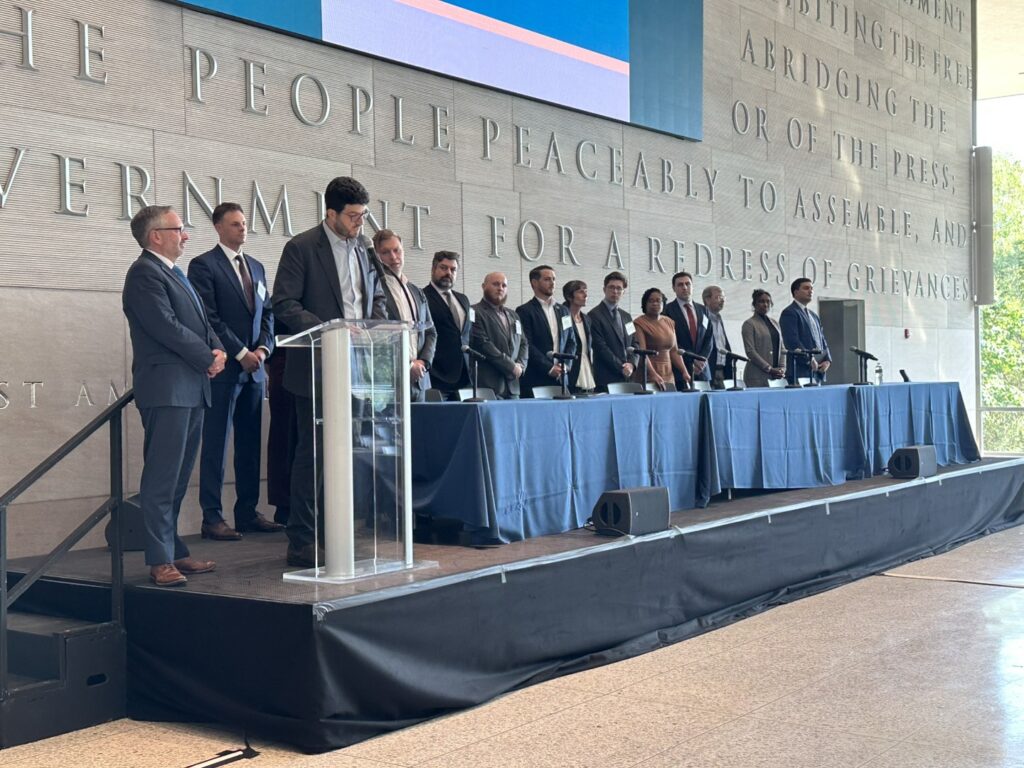
On September 22, 2025, with support from NGA and the Great Plains Institute, all 13 states convened a first-of-its-kind PJM Multi-State Technical Conference at the Constitution Center in Philadelphia, Pennsylvania. More than 500 participants attended the conference, with an additional 500 attending virtually. Attendees heard directly from Pennsylvania Governor Josh Shapiro in addition to NGA Vice Chair Maryland Governor Wes Moore, New Jersey Governor Phil Murphy and Virginia Governor Glenn Youngkin. Other speakers included state leaders, PJM leadership, critical stakeholders and experts from across the region. Technical sessions, each of which was moderated by a bipartisan pair of Governors’ office representatives, addressed resource adequacy challenges, innovative solutions to supply and demand constraints, governance lessons learned from across the country, and solutions for governance reform in PJM.
At the conclusion of the meeting, representatives from the Governors’ offices took the stage to announce a joint statement of intent to create a PJM Governors’ Collaborative, signed by 11 Governors, to develop a PJM Governors’ Collaborative to promote greater state and consumer representation in both decision-making processes at PJM.
Latest Actions: Governors and the Administration Issue Joint Principles Regarding PJM
On January 15, all 13 regional Governors joined U.S. Secretary of the Interior Doug Burgum and U.S. Secretary of Energy Chris Wright, both of whom lead President Trump’s Energy Dominance Council, to sign a Statement of Principles Regarding PJM to address ongoing affordability and reliability concerns in PJM.
These principles aim to (1) cut through the backlog of projects pending interconnection and accelerate the speed at which new power comes online, (2) have data centers cover their share of the costs of any new resources, and (3) stem the increase in auction prices to bring affordability back to the PJM region.
More specifically, these principles include:
- Trigger a reliability backstop auction by September 2026, an emergency mechanism to procure adequate generation resources to fill the gap left by the last base residual auction (BRA) and put in place a 15-year price guarantee to provide revenue certainty for generators.
- Allocate the costs of this additional backstop power to data centers through a two-part process:
- The principles direct PJM to allocate the cost of new capacity to load serving entities[3] (LSEs).
- Governors agreed to then use their authorities to have state regulators design new, large load rate classes that would allow the LSEs to allocate their share of new generation costs to data centers. Data centers that have procured their own power or agree to curtail their power usage during times of high demand are not expected to shoulder the costs from the Reliability Backstop Auction.
- Protect rate payers by continuing the existing price restrictions over to the next two base auctions, intended to freeze prices through 2030.
- Refine PJM’s load forecasting projections to only include real new demand,[4] improving the ability of states and the markets to project future power needs and avoid double-counting future energy-users.
- Institute a 150-day time limit for interconnection studies, vastly accelerating the interconnection process and bringing PJM into compliance with FERC Order No. 2023, which aimed to accelerate interconnection for electric generation and storage projects.
- Meaningfully engage stakeholders to reform the capacity market and return PJM to “market fundamentals” in time for the May 2027 auction.
As a non-binding set of principles, there is much work that remains to be done to ensure success. However, with bipartisan coordination and improved regional governance, Governors will continue working to protect their constituents from increasing electricity rates, develop their states’ economies, and ensure that power remains reliable and affordable into the future.

[1] An analysis by Grid Strategies found that nationwide, aggregated utility forecasts for new demand by 2030 were potentially overstated by as much as 40%, with utilities collectively projecting 90 GW of new power demand and other analysts projecting closer to 65 GW.
[2] Nine Governors signed the initial letter to the PJM Board of Governors. Ohio Governor Mike DeWine followed with a letter of his own supporting the previous, multi-Governor letter.
[3] A load serving entity in a deregulated electricity market is a company (like a distribution utility) or government entity responsible for providing power to an end user. The LSE buys power from a wholesale market, in this case PJM.
[4] Real new demand is defined as demand with an executed energy service agreement, credit or collateral support, or another material nonfungible commitment.