(Download)
Behavioral health workforce shortages remain a significant barrier to accessing care in rural areas across the United States. According to the Health Resources and Services Administration’s (HRSA) State of the Behavioral Health Workforce, (2025) substantial shortages are projected for many occupations in the behavioral health workforce over the next 15 years, including psychologists, psychiatrists, addiction counselors, mental health counselors, school counselors, and marriage and family therapists. Further, as of December 2, 2025, 40% of the U.S. population lives in a mental health Professional Shortage Area (HPSA), which show a shortage of mental health providers in an area, population group or facility setting. Contributing factors include reimbursement barriers that limit available services, high provider turnover and burnout. Recent federal funding opportunities, such as the Rural Health Transformation Program (RHTP), offer states an opportunity to support this workforce and increase access to behavioral health services for those living in rural areas.
Within their RHTP applications, states have addressed the workforce shortage and expanded services for patients. However, RHTP is a limited-time opportunity to build capacity and strengthen healthcare delivery across multiple systems, including primary care, emergency services and long-term care. Due to tight deadlines and competing priorities, states are prioritizing initiatives by directing resources toward programs that are already operational or have established provider networks ready to use the funds immediately.
Specific behavioral health priorities within RHTP include, but are not limited to:
Integrated Care Models
Expanding access to mental health and substance use disorder services in primary care settings through integrating care has been noted as one of the most efficient ways to expand access without relying on workforce growth. Through embedding behavioral health services into primary care settings, states can expand the capacity of their existing workforce to meet the demand with a qualified, well-distributed and supported staff.
In Illinois’ application, Initiative 3.1 B, identifies existing primary care providers as the first point of contact for mental health and substance use disorder (SUD) services. The foundation for this initiative already exists in the state’s primary care and outpatient behavioral health settings, and the initiative will work to integrate care models. The initiative will send funds to provider entities to support the establishment of integrated models of care, such as the Collaborative Care Model, by building clinical connections between rural primary care providers and specialists and embedding primary care providers and services in outpatient behavioral health settings.
Oklahoma is planning to build on an initiative that transformed all community mental health centers into Certified Community Behavioral Health Clinics (CCBHCs). CCBHCs are designed to provide a range of mental health and substance use disorder services to patients while also advancing the integration of behavioral health with physical health care. Through RHTP, Oklahoma is working to further integrate care by bringing together existing behavioral health and primary care providers who are interested in prescribing medication for opioid use disorder (MOUD) in primary care settings.

Additionally, the state aims to centralize complex services offered at main facilities and link them with smaller local clinics to ensure coordinated care for behavioral health patients. Complex services include, but are not limited to:
- Crisis services;
- Screening, assessment and diagnosis;
- Physical healthcare screening and monitoring;
- Comprehensive integrated care planning and
- Mental health and substance use disorder outpatient services.
Scaling Telehealth Services
Telehealth has been a tool for providers to address the barriers of long distances in rural communities. Telehealth extends the reach of behavioral health providers, enabling them to serve more patients across broader regional divides.
In Louisiana’s Initiative 5, the state identifies a focus on integrating care for high-need populations through coordinated, multimodal models and expanding partnerships for rural health providers to provide co-located care, such as MOUD and crisis response. For this specific initiative, telehealth is identified as one of the state’s multimodal strategies to reach patients. It is important to note that Louisiana has identified the need to increase telehealth infrastructure to support patient access to these services. The state’s application narrative highlights that telehealth companies will be key stakeholders in addressing potential challenges related to rural broadband access.
Workforce Incentives
Workforce incentives, such as recruitment bonuses, relocation assistance and capacity payments, are a tool to keep essential services operating. In terms of Opioid Treatment Providers (OTPs), essential in-person providers who operate in rural areas across the state to serve their patients, such incentives may help to bring more providers to rural areas to stabilize the workforce.
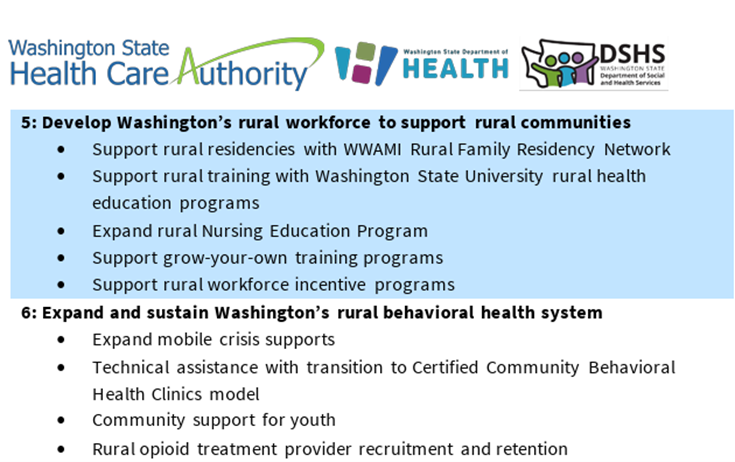
In Washington, the state will work to allocate funding toward establishing workforce incentive programs for rural OTPs. These providers are essential to patients who are in recovery from substance use disorder and who are in need of MOUD. The program would work to fund incentives such as recruitment bonuses, relocation support, childcare stipends, capacity payments and other approved incentives. The goal of this funding allocation would be to grow and stabilize the provider workforce to ensure access to OTP services around the state.
Braiding Funds for Sustainable Workforce Growth with RHTP
Many rural behavioral health initiatives already use grants and public reimbursement to finance services. The introduction of RHTP funding offers an opportunity for states and healthcare providers to braid funding streams, coordinating multiple sources to support a single program while tracking each stream separately. Since RHTP is a time-limited funding stream with a five-year horizon, states should plan for sustainable workforce growth.
As states scale workforce expansion efforts, they can look to supplemental grant funding to bolster training and service delivery.
Integrated Care Models
As states scale integrated behavioral health initiatives through RHTP, they can align these efforts with HRSA-supported training programs and technical assistance, such as those available through HRSA’s Addiction Medicine Fellowship, Graduate Psychology Education, and Integrated Substance Use Training programs, to strengthen provider readiness.
Telehealth Expansion
While building out telehealth networks with RHTP dollars, states can leverage complementary grant funding to support programs focused on direct services research, and technical assistance. States may also look into licensure compacts as pathways for interstate telehealth practices to enhance access across state boundaries. Health professionals must fulfill the licensure requirements of their own state or be legally authorized to practice in the patient’s state. Furthermore, providers who qualify under certain criteria may prescribe through telehealth, but they must comply with federal and state laws in both their location and the patient’s. These options could support maintaining care capacity via telehealth even after the five-year funding period.
Workforce Retention
Incentive programs funded through RHTP can also be supplemented by grants to help states avoid a fiscal cliff when the RHTP funding period ends. Past grant opportunities, such as the Nursing Education, Practice, Quality and Retention, worked to expand the workforce to increase nursing staff in rural areas.
Rural Health Transformation presents a time-limited but significant opportunity for states to strengthen access to rural behavioral health care. States are strategically investing in bolstering workforce capacity, integrated care models and service delivery innovations. By building upon existing initiatives and aligning RHTP with complementary funding streams, states can address immediate priorities while positioning these solutions for sustainable growth during RHTP implementation and beyond.