Rural Health Transformation Program Insights
(Download)
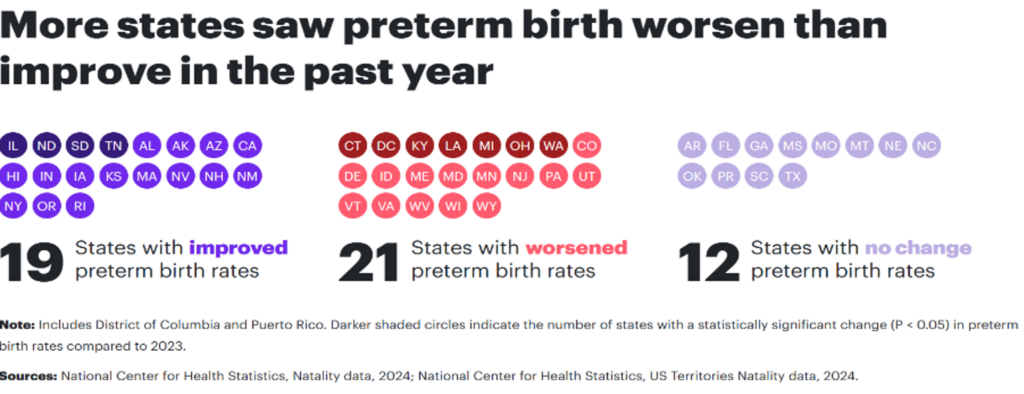
Maternal and child health (MCH) outcomes continue to raise national concern despite ongoing targeted initiatives, community-based interventions, and executive measures aimed at improving population health and saving lives. Although maternal mortality rates have decreased in recent years, the United States has seen maternal deaths well above global rates compared to other high-income countries, with the U.S. rate at 22 maternal deaths for every 100,000 live births. A March of Dimes’s 2025 Report graded the U.S. a D+ for preterm births, or births that occur before 37 weeks of pregnancy, indicating poor performance nationally with data showing preterm birth rates in 21 states and territories increasing compared to 2024.
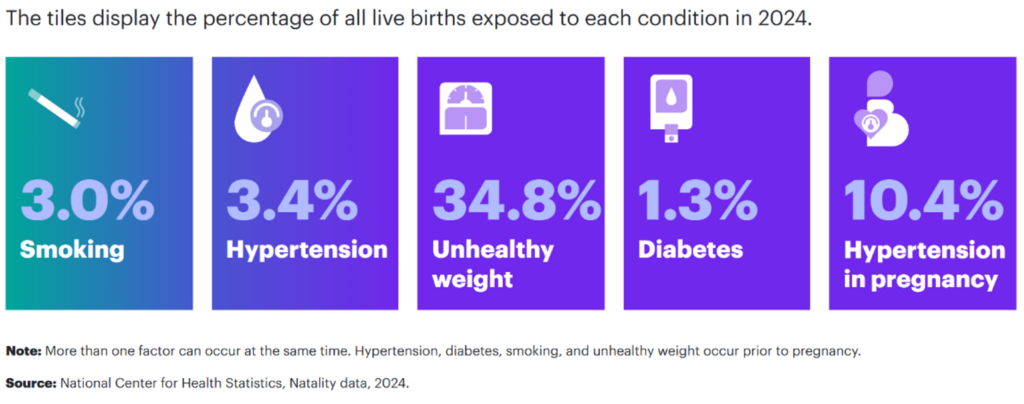
Some research suggests factors including but not limited to upstream drivers of health, workforce shortages, limited technology infrastructure and sustainability, and fragmented service delivery contribute to these poor MCH outcomes. Additionally, health behaviors that increase the risk of chronic conditions, when compounded by rural-specific access challenges, can lead to high-risk complications for both mothers and babies. Nationally, governors have led the charge to call attention to this public health crisis and maximize federal funding assistance to improve their MCH infrastructure generally and more specifically in the rural, frontier, or remote parts of their state or territory.
For example, Arkansas Gov. Sarah Huckabee Sanders and Maryland Gov. Wes Moore recently discussed their states’ focuses and the national need for bipartisan collaboration on maternal healthcare gaps and infrastructure improvements during an interview with NBC’s Meet the Press. Gov. Huckabee Sanders spoke about Arkansas’ Healthy Moms, Healthy Babies Act 2025 that allocated $45 to promote maternal health through Medicaid adjustments, introduced reimbursement pathways to diversify the MCH workforce, and established Medicaid coverage for pregnancy-related remote monitoring services in the state. While Gov. Moore highlighted his administration’s partnership with The Bridge Project, a program that provides direct financial support to mothers in Maryland, he also reinforced the need to utilize resources and financial assistance from federal, private, and public sector partnerships.
In December 2025, Center for Medicare & Medicaid Services (CMS) announced funding awards to all 50 states through the Rural Health Transformation Program (RHTP), with first-year awards rolling out in 2026. The funds are intended to help states continue to invest in the U.S.’s rural communities, develop robust rural infrastructure, and improve rural health outcomes through an innovative lens. States have submitted transformative and innovative proposals that build upon existing rural health initiatives or resources, while also introducing new strategies. These funds will allow states to strengthen maternal and child health access, address upstream drivers of health, and advance standout implementation approaches across the MCH workforce, technology-enabled care delivery and integrated care.
Workforce: Staffing, Recruitment, and Retention
Workforce shortages introduce unique disparities across rural communities, creating barriers for rural residents to access and maintain continuity of quality care. This is especially true for maternal care access, as nearly half of the U.S. is experiencing maternal healthcare workforce shortages. The following state plans for Rural Health Transformation Program funding propose innovative recruitment and retention strategies and staffing recommendations to diversify the MCH workforce, as well as provide access to comprehensive care for mothers in rural areas with specific health needs.
Delaware
Delaware is investing in a comprehensive workforce strategy centered on expanding the rural provider pipeline. Key initiatives include establishing the state’s first medical school, launching a “Train Here, Stay Here” residency program to encourage physicians to practice in rural communities, and expanding education and training opportunities for nurse practitioners, physician assistants, behavioral health professionals, long-term care staff, and other critical health care professions.
To support long-term workforce sustainability, Delaware will establish a Healthcare Workforce Data Center to monitor workforce capacity, track progress toward staffing goals, and evaluate the impact of Rural Health Transformation Program (RHTP) investments on the state’s rural health workforce.
Missouri
The Rural Health Workforce Program Initiative is intended to strengthen long-term rural workforce capacity by building sustainable career pipelines that begin in rural high schools and extend into maternal health and clinical training opportunities. The initiative will expand the maternal health workforce, create medical clerkship placements in rural hospitals, and support coordinated investments in Emergency Medical Services (EMS). It also incorporates the need for practical support, including temporary housing and childcare assistance, that can help workers remain in rural communities.
Technology Advancements & Regional Hubs
Historically, rural residents have faced barriers to accessing care facilities and access to specialized services due to geographic and transportation barriers. Advancements in technology have helped fill some of these gaps but have also introduced new issues around access to broadband, rural hospitals’ technology infrastructure capabilities, and fragmented regional systems, ultimately impacting care coordination. Telehealth and remote monitoring have proven useful to bridge gaps in health access for rural communities by addressing transportation barriers. The state implementation plans listed below explore innovative technology advancement and regional hub integration.
Alabama
The Maternal and Fetal Health – Obstetric Digital Regionalization Initiative is designed to strengthen access to high-quality maternal and fetal care in underserved communities, particularly in rural areas where obstetric services are limited. Through technology incorporation, the initiative would connect rural health care facilities with maternal-fetal medicine specialists and expand access to telerobotic ultrasound, helping providers identify and manage high-risk pregnancies more effectively.
- The initiative also builds on an existing pilot project that provides emergency Labor and Delivery (L&D) services to health care facilities without dedicated L&D units. This approach is intended to deliver lifesaving care in communities with limited obstetric capacity and support improved maternal and infant mortality outcomes.
In addition, the proposal includes Regional Care Hubs development that would link local facilities with a central coordinating provider. These hubs aim to ensure that patients and providers can access specialty services that may not be available at the regional level, creating a more coordinated system of care for high-risk maternal and fetal health needs.
Illinois
The Carle Health Project is focused on expanding maternal and child health support in Vermillion County by strengthening services that meet families where they are.
The project will expand an MCH-focused RN Home Visiting program, invest in mobile market capacity, increase access to a mobile health clinic, and reinforce behavioral health service capacity to better support residents across the county.
Integrated Care and Service Delivery
Integrated care allows for a comprehensive, patient-centered approach providing care to maternal and child populations. It introduces the opportunity to bridge primary care, behavioral health, and social services to streamline services and reinforce care coordination. Introducing integrated care models to rural MCH populations can allow for increased utilization of preventative care, specialty care, and reduced hospitalization or readmissions. The implementation plans below explore wrap-around rural MCH service delivery.
Georgia
Georgia is seeking to add a nutrition and weight management eligibility category to its Planning for Healthy Babies Medicaid demonstration program that provides no cost family planning services to eligible women. This proposed expansion would provide weight management supports – including dietician and nutritionist services, primary health care case management, and access to weight loss medications such as GLP-1s –for women ages 19 to 44 who meet certain clinical requirements to decrease the likelihood for dangerous pregnancy complications.
North Carolina
The state plans to expand its existing NC MATTERS program into rural communities, extending access to an innovative perinatal psychiatry model that connects obstetric, primary care, and mental health providers. By strengthening coordination across these providers, the program aims to create a more integrated system of care for pregnant and postpartum individuals with behavioral health and substance use needs.
These examples represent just a small selection of the awardee implementation plans focused on Maternal and Child Health from the RHTP applications. All states demonstrated their ongoing commitment to invest in rural health systems and resources in their states to ensure rural residents consistently have access to high-quality health care and improved outcomes. For more information about NGA’s Rural Health and Maternal and Child Health portfolio, please contact Asia Riviere.
This publication was supported by the Health Resources and Services Administration (HRSA) of the U.S. Department of Health and Human Services (HHS) as part of a financial assistance award under the National Organizations of State and Local Officials (NOSLO) cooperative agreement totaling $1,585,000 with 100 percent funded by HRSA/HHS. The contents are those of the author and do not necessarily represent the official views of, nor an endorsement, by HRSA/HHS, or the U.S. Government.