Clemency is a form of executive authority exercised by the President and by the Governors of each state to forgive or mitigate certain criminal penalties or to relieve individuals from certain legal consequences of a conviction.
Every state constitution authorizes the Governor or a Board of Pardons to grant clemency, though terminology, procedure, structure, and the use of this power varies greatly from state to state. Clemency is an umbrella term that refers to several mechanisms that allow for the remittance of consequences of a committed crime, and generally refer to the following executive powers:
- Pardon. A pardon is an official nullification of legal consequences for a crime. The granting of a pardon by the Governor or formal Pardons Board may restore certain civil rights, such as the right to vote, the right to bear arms, or the ability to run for office or serve in the military. It may also remove some legal barriers to employment and licensing.
- Commutation. Commutation shortens an individual’s sentence. If a commutation shortens an individual’s sentence to time served, it results in that individual’s release. Upon release, an individual whose sentence is commuted may remain on community supervision or may be released without ongoing supervision.
- Reprieve. A reprieve suspends an individual’s sentence or temporarily delays the imposition or resumption of a sentence, including for an individual with a capital sentence.
State statutes and regulations often provide the procedural rules, notice provisions, and application requirements that allow the executive to exercise its authority. Some states follow internal guidelines or criteria for granting clemency, often taking into account the full history of the applicant, the reasoning behind the request, and other personal factors. Because the granting of clemency is the prerogative of the Governor and/or Board, Governors may analyze the individual circumstances of an application and use their respective discretion when making decisions.
The number of pardons and commutations granted each year varies greatly from state to state and across administrations. This number may also vary greatly year to year in any given state or territory. States that utilize a Pardon Board structure, which typically requires a more formal application process and more frequent hearings, often grant pardons and commutations in higher numbers and on a more regular basis.
State Pardon Processes:
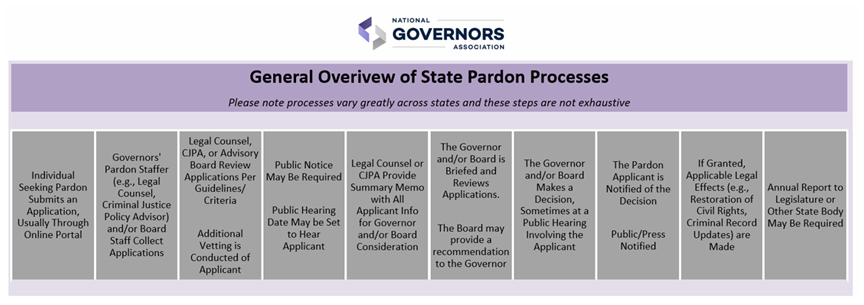
A pardon is an act of executive clemency that forgives a criminal offense, removes the legal penalties associated with a conviction, and restores certain civil rights. Gubernatorial staff may create a formal clemency review process within the Governor’s office for capital and noncapital cases. Though respective state processes vary greatly, a general pardon process may include the following steps:
Depending on respective statutes, states may establish informal standards or eligibility requirements that apply to individuals seeking a pardon. Different standards may be required depending on the nature of the crime (e.g., whether the crime was a felony or a misdemeanor, involved a sex crime, or involved a serious or violent offense) and how long it has been since the crime was committed. States often require any restitution or court fines to have been paid before being eligible for a pardon. Mental health assessments or psychiatric examinations may also be a component of pardon or commutation proceedings. Additional provisions may be required for out-of-state offenses. In considering general clemency, Governors may weigh several factors, including:
- The circumstances of the crime;
- The age of the individual at the time of the commission of the crime;
- Subsequent criminal history;
- Time that has lapsed since the crime was committed;
- Letters of character support from the individual’s family or community;
- Reasons the individual is seeking the pardon;
- Payment of needed fines and fees;
- Signs of rehabilitation (e.g., stable employment, community engagement, steady religious influence, charitable works, educational attainment, substance use treatment, or lack of prison infractions); and/or
- Victim input.
Recently, some Governors have used their clemency powers to issue mass pardons to individuals with certain convictions, often related to marijuana possession. Mechanisms for issuing such mass pardons have varied. Some Governors have issued executive orders granting pardons and others have established initiatives streamlining application processes. Many of these actions have accompanied marijuana legalization efforts. Marijuana expungement laws may also provide explicit pathways to expunge the records of those with certain marijuana convictions.
State Commutation Processes:
Commutation is a form of executive clemency that reduces an individual’s punishment—most often by shortening a prison sentence. Commutation is a rarer occurrence and is a separate and distinct process from granting a pardon or parole. However, commutation and pardon applications may be collected through similar procedures, and the Governor or Board may set a hearing date to hear both pardon and commutation applicants during the same meeting.
In most states, the authority to commute sentences rests with the Governor, sometimes in coordination with a Board of Pardons or Parole that conducts investigations or provides recommendations. Eligibility requirements typically limit applications to individuals convicted of state offenses who are serving their sentences in state facilities, and these rules often specify how much time must be served, whether the person is parole-eligible, and other statutory criteria. In evaluating requests, decision-makers consider factors such as demonstrated rehabilitation, medical needs, compassion, updated sentencing guidelines, or concerns that a sentence is disproportionately harsh. With some exceptions—such as impeachment or treason—most sentences can be commuted, and some states allow for additional adjustments, including converting consecutive terms to concurrent ones or reducing capital or life sentences under defined circumstances.
The commutation process generally requires a formal application, followed by investigative review by corrections or parole authorities and opportunities for input from courts, victims, and other stakeholders, often culminating in a public hearing. If a commutation is granted, it may include conditions designed to promote rehabilitation and community safety. Violating these conditions can result in reinstatement of the original sentence, subject to applicable due process requirements. While commutation can lead to immediate release if the sentence is reduced to time served—or to continued supervision if a shorter sentence remains—it does not automatically restore civil rights lost due to conviction.
NGA holds monthly briefings for Governors’ legal counsel. Please reach out to Lauren Dedon (Ldedon@nga.org) for additional information.