
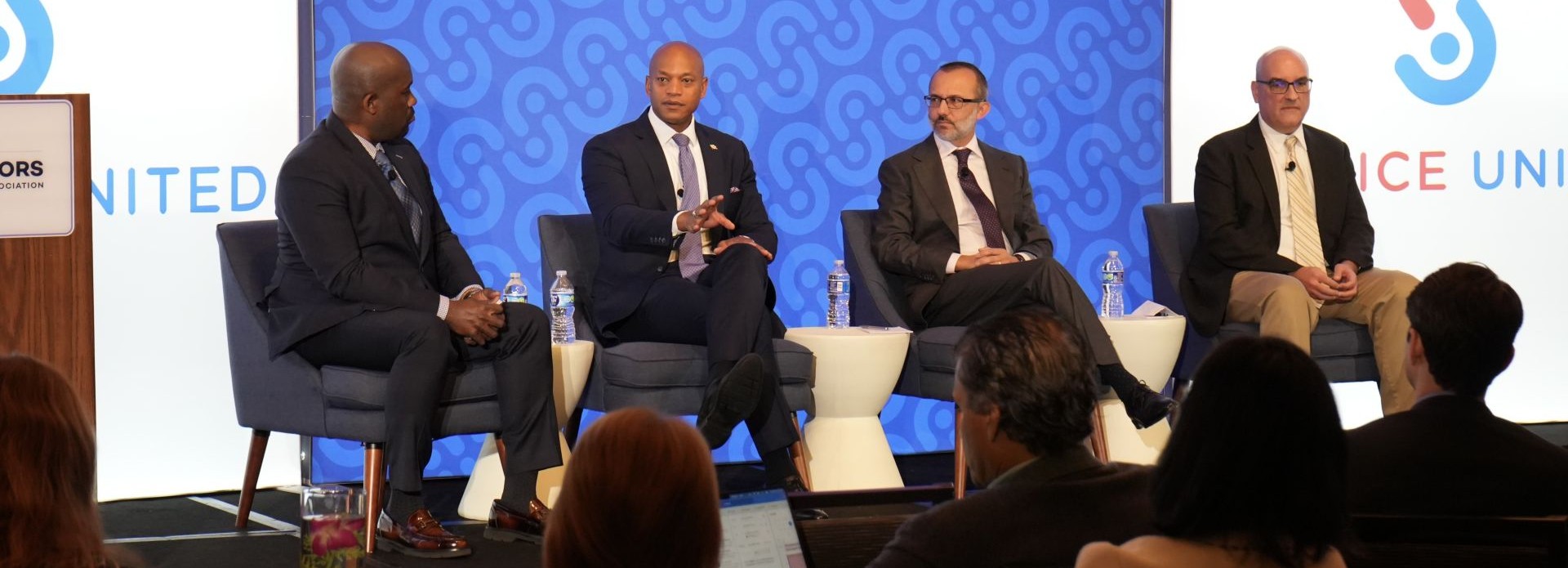

2026 Chair’s Initiative Fall Convening
Maryland Gov. Wes Moore, chair of the National Governors Association, welcomed workforce, service, and philanthropic leaders from 23 states and territories to Annapolis, Maryland, Oct. 7-8, 2026 to explore the power of service as a workforce development and community engagement tool. Democrats and Republicans sat side by side to compare notes on how to make service a standard part of how states build their workforce, meet local needs and bring people together.
Welcoming Remarks
The day opened with a young person’s story. A Maryland alum of the Service Year Option and the state’s Youth Mental Health Corps shared how a stalled start to adulthood, after college plans fell through, turned into a paid year of service, new skills, and a permanent job in a field she loves. It set the tone for everything that followed: service is not charity or a gap year, but a real on-ramp to work.
Gov. Moore then made the case for why service matters now, arguing that service drives community progress, leads into meaningful careers, and builds bonds across communities, pointing to more than 5 million young Americans ages 18 to 23 who are neither in school nor working. Maryland, the first state to offer a paid year of service to high school graduates, previewed early results from an independent University of Maryland evaluation: better employment outcomes, a 57.5% rise in hourly wages for members who already had jobs (compared with 22% in a comparison group), and higher voter registration.
The governor then closed with a call to action. States can apply to the Service United Fund for grants of up to $1.5 million to plan, build, or expand programs, with a first round open now and a second opening next year, to further the goal of 1 million young people serving every year by the end of the decade. State leaders were asked to take home three tasks: name the most urgent need in a state that paid service can address, build a model to recruit and support young people, and make sure every term of service leads somewhere, whether a credential, an apprenticeship, school, or a job.
Service from All, Opportunity for All
Featuring Maryland Gov. Wes Moore; Dr. Nathan Dietz, Do Good Institute, University of Maryland; Dr. Mario Macis, Johns Hopkins Carey Business School. Moderated by Mario Parker, Bloomberg News.
This headline conversation began with why service became a priority: a conviction, rooted in military experience, that people from different backgrounds and parties can work toward a common mission, and that it can be done at scale. Researchers then walked through the evidence. Comparing program alumni with a similar group from Census Bureau data, they found significant gains in employment and in wages for those already working, with benefits showing up in the first year and holding in the second. The share of members both studying and working for pay rose too, a sign the model’s flexibility helps people seize opportunities. Civic participation outside elections did not change much, which researchers attributed to early participants already being civically minded, and they expect larger programs to give a clearer read.
The economic backdrop was just as important. Young people without a network, a degree, or a visible track record are routinely undervalued in the job market, hiring of young workers has slowed in AI-exposed fields, and meanwhile communities face shortages in healthcare, education, and other fields. Service works as a bridge. A four-part recipe for success emerged: target the young people who are not getting a first chance, build skills employers value, produce credentials that make traits like reliability visible, and match participants and host organizations deliberately. Cost-sharing between the state and hosts keeps positions real, reduces stigma, and reassures taxpayers.
On AI, the discussion acknowledged real public anxiety while describing practical uses in state government, with people kept at the center and governors working together on guardrails. Service was framed as part of the answer to coming disruption, building durable skills like teamwork and communication. The conversation also explored how to frame the program for voters as a workforce development and economic advancement strategy, rather than a feel-good volunteer program, stressing the need to emphasize that service programs deliver a strong societal return from a small share of the budget, while considering Maryland chose to own the model itself, a decision that let the program keep growing when federal support wavered. Above all, panelists said the model should be community-led, with each region defining its own needs.
Service that Works: State Innovations in Linking Service to Careers
Featuring Allison Bertl, Indiana Department of Workforce Development; Jonny Dorsey, Maryland Department of Service and Civic Innovation; Alison Dorsey Eden, Office of North Carolina Governor Josh Stein; Kathy Spangler, Serve Virginia. Moderated by Kenny Williams, Guild.
Four states showed four different doors into the same idea. Maryland picks focus areas by asking where service can make a real difference, connect to careers, and build bonds across differences, and the state is scaling education and health pathways with proven models, while also following opportunity when an employer or funder is ready to partner. North Carolina is using service to strengthen rural communities, drawing on listening sessions that surfaced capacity gaps in county government and shortages in teachers and healthcare workers, and on lessons from recovery after Hurricane Helene. Indiana houses service in its workforce agency, building stackable credentials into service terms so a young person can move toward an apprenticeship. Virginia began with data, running a statewide community engagement survey whose findings helped shape a youth mental health corps and a statewide volunteer hub.
The second half turned to how to make it last. Maryland was candid that it initially subsidized small nonprofits more than large employers, then shifted toward major employers by pitching service as a talent pipeline rather than a favor, a shift that takes real senior-team time. Panelists described braiding funding streams, tying service to other evidence-backed programs such as community health workers, and weaving service into workforce policy through apprenticeship goals and state-government placements.
Their advice to peers was practical: bring credible economic voices, such as a labor economist or commerce leader, into the conversation; lean into how service connects with what your state is already doing, blending and braiding dollars instead of starting over; and rally partners around shared goals like the healthcare talent shortage or storm recovery. Additionally, states were advised to play the long game, with an approach that can succeed across administrations.
Empowering the Next Generation of Leaders: Maryland Service Member Perspectives
Featuring four Maryland service members, facilitated by David Cobb, Service Success Coach, Maryland Department of Service and Civic Innovation.
The most memorable session of the day belonged to the people the program is built for. Four members, serving at a media host site, a charter school, the state emergency management agency, and a medical center, described what service means to them: showing up for people, sacrificing for others, and using your gifts so others feel they matter. Their paths in were varied. Some found the program through a relative or on social media, one expected a teaching-assistant job and discovered it was a service role, and one had spent months applying for jobs after leaving warehouse work before landing a sterile processing placement.
The biggest surprise for participants was how real it was. Members found paid, substantive jobs with serious responsibility, plus a support system around them: a success coach, free online learning and certificates, confidence-building, and a network of peers in the same field. Several said the year clarified a career direction that had been vague, and some came back as second-year leaders or went on to permanent roles.
Their message to anyone on the fence was clear: it is not a gap year, it is an investment in yourself, and even a first placement that is not the dream job opens doors. To leaders thinking about launching a program, they urged investing in young people who are eager to serve, noting that the benefits stay in the state and that adults have a responsibility to pour into those coming up behind them.
Opportunities for State-Federal Collaboration
Featuring Jennifer Bastress Tahmasebi, Interim Agency Head, AmeriCorps.
Bastress Tahmasebi described what the agency sees across the country: members supporting students, responding to disasters, conserving public lands, serving veterans and military families, and strengthening food security and health services. An independent study found a return of $17 for every federal dollar spent. The central message was that service changes communities and also the trajectory of those who serve, building leadership, teamwork, and problem-solving that count as workforce skills. The federal role is infrastructure, funding of roughly $1.2 billion, and national partnerships, while states know their own needs best.
Bastress Tahmasebi noted that recent budget cuts reduced its operating funds and staff, leaving many people with the impression that it had closed. The message was that AmeriCorps is open for business, and that more grant dollars were awarded this year than ever before, a result credited to governors across the political spectrum, state service commissions, and national advocacy groups. Her remarks closed with an invitation to states to name their biggest challenge, identify the talent needed to meet it over the next several years, and ask what role service can play, building the future of national service together with states and communities.
National Partners United in Service
Featuring Melissa Chabran, William and Flora Hewlett Foundation; Marie Groark, Schultz Family Foundation; Lane McBride, RAISE US; Dan Vallone, Andrew Carnegie Foundation. Moderated by Timothy Blute, President and Chief Policy Officer, National Governors Association.
The closing panel brought together the philanthropic and national partners backing Service United. It opened with an update on the new fund, launched in August, which offers planning, build and impact grants to help states shape strategies around the initiative’s three pillars. The youth mental health corps was highlighted as a proof point of the double or triple bottom line of service: better well-being for young people and a pipeline of staff for a sector with growing workforce needs. A major announcement followed: a $1 million investment in the national association of state service commissions, paired with a consulting partner focused on economic prosperity, so that service can be carried into conversations with workforce and higher-education leaders.
Other partners offered their angles. A new group focused on AI and the American workforce said entry-level work is already feeling the pressure, noting that service is an entry point to hands-on, AI-resilient careers, starting with a project in Maryland. A foundation just beginning its service journey tied it to a long-standing focus on deeper learning, a close cousin of durable skills, and to young people’s appetite to solve problems together in a polarized time.
A highlight was the research on polarization. A review of studies, from military service in several countries to civilian programs, found that meaningful service is associated with lower political polarization and stronger connection across class, race, region, and religion. Four ingredients make it work: people from different backgrounds on equal footing, enough time together to work through conflict, meaningful shared work, and a consciously cultivated shared identity. The panel closed by discussing how to build and measure good programs, noting a need to put employers at the table early to design credential pathways, show hosts real value beyond corporate social responsibility, plan financing well beyond early federal capital, and protect the quality of the service brand so it signals a strong program everywhere.