

Service in Action
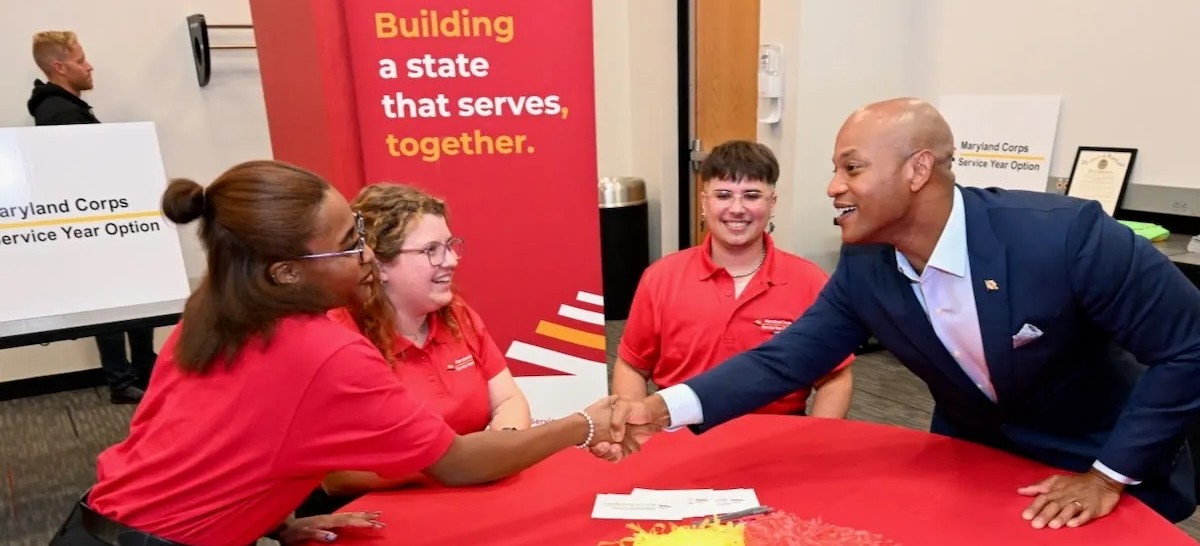
Maryland Service Year Option
Maryland is proving that service can be a workforce strategy. The Service Year Option, the first program of its kind in the nation, gives young adults who have recently finished high school a paid year of service and a head start on a career.
Meeting real needs. Participants are placed with a host site aligned to their interests, from education and conservation to health, information technology and public safety. The Department of Service and Civic Innovation partners with nonprofits, businesses, governments and colleges to host them.
Building careers. Participants earn at least $15 an hour plus a $6,000 completion award. Depending on their path, they can also earn credentials in skilled trades and apprenticeships that lead to further education or work.
Forging bonds. The program is designed to be open to young people from all 24 jurisdictions in Maryland, bringing together participants from different backgrounds.
Since its inception in April 2023, the Maryland Corps/Service Year Option program, facilitated by the Department of Service and Civic Innovation, has graduated over 1200 Members hosted by over 300 employment partners across all 24 jurisdictions of Maryland.
One Utah Service Fellowship
Utah is building its workforce and its communities at the same time. Launched in fall 2024 by Gov. Spencer Cox, the One Utah Service Fellowship gives young adults paid, hands-on service experience and a debt-free path to higher education. It reflects the approach at the heart of Service United: service as a workforce strategy that meets community needs, builds careers and brings people together.
Meeting real needs. Fellows serve in fields such as education, health care, public health and construction, at nearly 300 service sites across 26 of Utah’s 29 counties.
Building careers. Fellows receive a monthly stipend and an education award on completion. The fellowship builds practical skills and can lead to certifications employers value.
Forging bonds. Rooted in the governor’s “One Utah” vision that everyone is invited, fellows serve communities statewide, from urban centers to rural counties.
It was the first of its kind in the nation to combine state, private and federal funding in an AmeriCorps program, and Service Year Alliance has named it a national leader.
Arkansas Youth Mental Health Corps
Arkansas is putting service to work on two urgent needs at once: a youth mental health crisis and a behavioral health workforce gap. As one of five states joining the Youth Mental Health Corps for 2026-27, Arkansas will pay young adults to serve as near-peer mental health supporters in schools and communities.
This is Service United in practice: not make-work volunteering, but a paid workforce and community development strategy.
Meeting real needs. Corps members serve at host sites, reaching young people before crisis. The Arkansas Crisis Center reports that about 70 percent of its text-line contacts come from people under 18.
Building careers. Members earn pay, training, credentials and experience, with a clear path into behavioral health, turning service into a talent pipeline.
Forging bonds. Serving side by side, young adults from different backgrounds build trust that strengthens communities.
The model works. Launched in 2024 by the Schultz Family Foundation and Pinterest, YMHC has trained nearly 1,000 members, and an independent WestEd evaluation found fewer behavioral referrals and better attendance.
Colorado Public Health Works
Colorado is answering a public health workforce shortage by turning service into a paid career pathway. Colorado Public Health Works (CPHW), launched in 2022 by Trailhead Institute and Serve Colorado with the state Department of Labor and Employment, was the first program to integrate AmeriCorps with a registered apprenticeship.
Meeting real needs. Members serve at local public health agencies across the state, adding capacity where communities need it most.
Building careers. Young people ages 17 to 25 serve as AmeriCorps members while pursuing Community Health Worker certification through a U.S. Department of Labor registered apprenticeship. They earn while they learn, graduating with experience, credentials and a direct line to employers.
Forging bonds. Drawn from local communities, members serve their own neighbors and build trust between residents and the public health system.
The model is built to spread. Serve Colorado and Trailhead published a guide and case study so other states can combine AmeriCorps and apprenticeship funding, and Trailhead continues to expand the program with new funding.