America’s energy problem is not resources, it is speed. Governors from both parties have united behind a package of commonsense permitting reforms to build the infrastructure the country needs faster, cheaper and with more certainty.
Reducing the time and cost of approving major infrastructure projects has been a top priority for governors. Through the bipartisan Governors Energy and Infrastructure Working Group, a package of federal reform priorities delivered to Congress, and a program of convenings and technical assistance for governors’ infrastructure coordinators, the National Governors Association (NGA) is working to ensure that permitting processes are streamlined, predictable and administered in a technology-neutral and apolitical manner that allows projects of all types to move forward.
Governors Energy and Infrastructure Working Group
At NGA’s 2025 Winter Meeting, governors announced the formation of a bipartisan working group to improve federal permitting and regulatory processes for critical energy infrastructure. Co-chaired by NGA Chair Oklahoma Gov. Kevin Stitt and Pennsylvania Gov. Josh Shapiro, the group of 13 governors spent nearly a year soliciting ideas for project acceleration and diagnosing barriers at both the state and federal level, working on behalf of all 55 states and territories.
“This isn’t a Republican or Democrat issue. Every American needs to heat their home and power their vehicle.” — Oklahoma Gov. Kevin Stitt
In October 2025, the working group released a package of reform priorities in a letter to congressional committee leaders across five committees of jurisdiction. The recommendations build on a 2023 bipartisan governors’ permitting vision that was ultimately incorporated into the Fiscal Responsibility Act.
“A slow yes is often worse than a fast no. If we’re going to take three years to clear your permit, that’s worse than just saying no. We’ve got to make decisions, make them quickly, and move forward.” — Delaware Gov. Matt Meyer
The Reform Priorities
Amid rising demand for electricity to serve computing, industrial, manufacturing, building and transportation needs, governors developed recommendations across five categories. Effective implementation depends on federal agencies having adequate staff and resources, and on decisions that investors and developers can rely on with certainty.
Streamlining Federal Agency Reviews
Adopt common interagency digital systems, ePermitting and shared application fields and formats. Make AI tools available to applicants to identify common issues before submission, and unlock the broader suite of automation and AI tools for applicants and agency staff — subject to appropriate safeguards and human review — to accelerate review. Devolve permitting decisions and consultations to the staff level, ensure agencies are adequately staffed to make timely decisions, and codify a technology-neutral prohibition on retroactive permit or lease cancellation.
Reforms to the National Environmental Policy Act
Designate FERC as lead agency for federal transmission reviews and move cross-border energy projects out of the State Department. Expand categorical exclusions — contingent on the relevant governor’s approval — for responsible development on brownfields and previously disturbed lands, covering transmission within existing rights-of-way, grid-enhancing technologies, carbon capture retrofits, geothermal exploration, co-located storage, nth-of-a-kind small modular reactors and microreactors, low-impact hydropower and more. Broaden FAST-41 eligibility by lowering the investment threshold from $200 million to $50 million. Enforce and further reduce the environmental review timelines codified in the Fiscal Responsibility Act, give applicants an expedited pathway to petition courts when deadlines are missed, and refund permit fees when timelines lapse — a money-back guarantee that has already driven significant improvement in several states. Reduce the statute of limitations for NEPA suits from six years to one year or less, set a six-month limit for agencies to act on remand, and prioritize energy permitting cases in the courts.
Reforms to Interstate Energy Transmission
Require FERC to create a National Interest Designation Process for transmission facilities, with consultation of affected states, and allow groups of states to nominate National Interest Electric Lines. Require regional transmission organizations to prioritize grid-enhancing and alternative transmission technologies in planning. Give FERC greater flexibility to allocate interstate and offshore transmission costs among project beneficiaries. Establish that it is not just and reasonable for an RTO or ISO to deny states complementary filing rights, or to fail to fulfill an interconnection request within six months of a complete application.
Reforms to Nuclear Energy Regulation
Allow Environmental Assessments in place of Environmental Impact Statements where appropriate, finalize a generic environmental review for advanced reactor construction and operation, and expand categorical exclusions to small research reactors, suitable brownfield sites and repowering of existing or recently retired facilities. Create an expedited licensing pathway for reactors using an unmodified existing design, proactively certify likely variations on small modular reactor and microreactor designs, reform licensing fee structures, and simplify or end mandatory hearings on uncontested issues. Allow the NRC to certify states to perform parts of the siting review in exchange for the state assuming responsibility for related litigation.
Reforms to the Clean Water Act
Give states the option to extend NPDES permit duration by up to five additional years for projects unlikely to change materially and allow states to receive applications and data concurrently with federal agencies. Codify processes for state primacy in Clean Air Act and Clean Water Act permitting, expedite Class VI well primacy applications and consider reimbursement for states carrying delegated responsibilities. Set application processing timelines with refunds when they are missed, front-load public participation to the earliest possible stage and codify a statute of limitations for challenges to Section 401 water quality certifications.
Why Permitting Reform Matters
The physical work of building is no longer the binding constraint. Construction, supply chains and labor can be aligned on reasonable timelines; it is the regulatory overlay, and the litigation that follows it, that now determines whether projects happen at all. The United States is among the slowest nations in the developed world at greenlighting new projects — a strategic liability for a country that is otherwise energy self-sufficient.
The comparison governors return to is nuclear: the Vogtle reactors in Georgia took roughly 15 years to complete, while China brings eight to 10 reactors online each year on a five-to-six-year timeline. The costs of delay are local as well as geopolitical — hospital expansions, housing, transmission lines and manufacturing plants all wait in the same queue.
Governors increasingly describe permitting delay as a hidden cost passed to consumers. Oklahoma Gov. Kevin Stitt has said pipeline developers in his state now spend as much to permit a project as to build it, and points to an estimated $1.7 trillion in annual regulatory cost borne by American consumers. Delaware Gov. Matt Meyer notes that roughly a third of the cost of building a new home in America is not the home itself but the soft costs of navigating government—a delay his administration treats as a direct increase in what residents pay.
Rising electricity demand from data centers, advanced manufacturing and electrification has raised the stakes. Reform that moves projects faster is simultaneously an affordability strategy, a grid reliability strategy and an economic competitiveness strategy. Effective reform has to operate on three fronts at once: compressing approval timelines, narrowing post-approval litigation, and building the workforce and tooling that make faster buildout possible.
Governors Leading
With federal action stalled, states have become the proving ground. Governors are advancing their own reforms both to move projects now and to give federal policymakers a roadmap drawn from state success stories.
Setting Deadlines and Standing Behind Them
Pennsylvania moved from 48th in the nation on permit processing time into the top five. The commonwealth now timestamps every permit, has issued permit approval rates and refunds applicants when deadlines slip; only five refunds have been issued. Gov. Shapiro’s PA Permit Fast Track program adds dedicated coordination between project sponsors and state agencies for priority projects. “The government has to move at the speed of business,” Gov. Shapiro has said.
Oklahoma adopted a version of Pennsylvania’s approach directly. Gov. Stitt has credited Gov. Shapiro’s executive order as the model for Oklahoma’s own policy making state permits free to the applicant if not issued within 30 days—while keeping federal environmental standards and state Department of Environmental Quality review fully intact.
In February 2026, Delaware Gov. Matt Meyer signed an executive order capping permitting timelines at six months, down from an 18-to-24-month average. The order replaces a multi-agency paperwork maze with a single unified application form, adds technology-driven completeness checks that return instant feedback, and assigns a dedicated ombudsman to every complex project. “We cannot reignite the American Dream if this is how long a state takes to build things,” Gov. Meyer said at NGA’s Energizing the American Dream convening held in Philadelphia in April 2026.
New Jersey Gov. Mikie Sherrill has expanded the state’s Business Action Center, digitized paper-based processes and built a permitting “shot clock” that lets applicants track status in real time. She has also urged the federal government to template nuclear development — standardizing plans, training workforces and sequencing construction at scale to bring costs down.
Powering Growth Without Passing Costs to Ratepayers
Oklahoma’s “behind the meter” law allows data centers to tap natural gas and build their own generation rather than waiting out multi-year interconnection queues with regional grid operators. The state is number six in oil production and number five in natural gas. Oklahoma is also number two in wind-generated electricity—a mix Gov. Stitt cites as evidence that a technology-neutral posture works.
West Virginia’s House Bill 2014 enables behind-the-meter projects and routes half of data center revenues into a fund intended to eliminate the state income tax once local counties are funded. West Virginia Gov. Patrick Morrisey’s “50 by 50” plan would scale generation from 15.9 GW today to 50 GW by 2050, and Google recently announced its first West Virginia data center. Gov. Morrisey has emphasized local buy-in as a prerequisite rather than an afterthought.
Pennsylvania applies a four-part “Governors GRID” test to data center projects: bring your own power and pay for it, deal transparently with local communities, hire local under community benefits agreements and protect the environment. New Jersey has raised concerns that the regional data center buildout has driven up costs across the PJM footprint and that risk continues to be pushed back onto states.
Building the Systems Underneath
At NGA’s Spring 2026 Infrastructure Coordinator Workshop, governors’ advisors emphasized that state-level permitting reform requires whole-system thinking, because permitting systems in one sector are bound up with all the others. AI can help speed permits but is not a substitute for sound underlying processes. Cross-agency coordination matters not only for accelerating environmental approvals but for aligning infrastructure deployment with land use and housing — coordination that often meets initial resistance before peer-to-peer dialogue breaks down silos. Advisors also pointed to technologies like digital twins, which help communities visualize projects and can speed approvals, particularly in areas with smaller budgets and limited workforce.
The Federal Landscape
Despite House passage of the SPEED Act, which focused on NEPA reforms, progress on federal permitting legislation has stalled in Congress. Governors have identified this as an opening for states to advance their own reforms and position themselves ahead of federal action. At NGA convenings, private sector participants consistently stress the same point: investors and developers prioritize certainty and streamlined process, and executive orders and administrative actions are seen as fragile — reforms need to be locked into statute to give investors a runway.
Permitting also runs through the surface transportation debate. With the Infrastructure Investment and Jobs Act set to expire in September 2026, NGA’s Economic Development and Revitalization Task Force wrote to congressional leaders urging a timely, bipartisan reauthorization that upholds the state-federal-territorial partnership, ensures robust and predictable funding, and increases flexibility through formula programs. In July 2025, North Dakota Gov. Kelly Armstrong testified before the Senate Committee on Environment and Public Works on behalf of NGA, urging efficiency, certainty and transparency in permitting. Governors’ advisors have welcomed the House BUILD America 250 Act’s focus on formula funds, new revenue opportunities and permitting reform elements, while flagging concerns that proposed funding may not keep pace with inflation.
Governors describe the problem as a mismatch between project timelines and political ones: major infrastructure takes the better part of a decade to permit and build, while federal posture can reverse every four years. Gov. Stitt has cited the repeated approval, cancellation and revival of the Keystone XL pipeline as the clearest illustration — and applies the same objection to projects he would not have developed himself.
Related NGA Work
- Common Ground at the 2026 Summer Meeting. NBC News Meet the Press moderator Kristen Welker opened NGA’s 2026 Summer Meeting in Oklahoma City with a bipartisan conversation between Gov. Stitt and Delaware Gov. Matt Meyer as part of the network’s Common Ground series. Permitting ran through the discussion as a driver of housing costs, energy reliability and business formation — with both governors describing delay itself, rather than any single regulation, as the core problem.
- Energizing the American Dream. In April 2026, NGA brought five governors together with energy leaders and private-sector voices in Philadelphia for a convening related to Gov. Stitt’s Reigniting the American Dream Chair’s Initiative. The convening focused on how states are outpacing Washington on building reliable, affordable energy infrastructure.
- Red Tape and Rising Demand. At the 2026 Winter Meeting, governors discussed energy demand and permitting, concluding that America’s ability to build energy and data infrastructure quickly is a national security question, not only a policy debate.
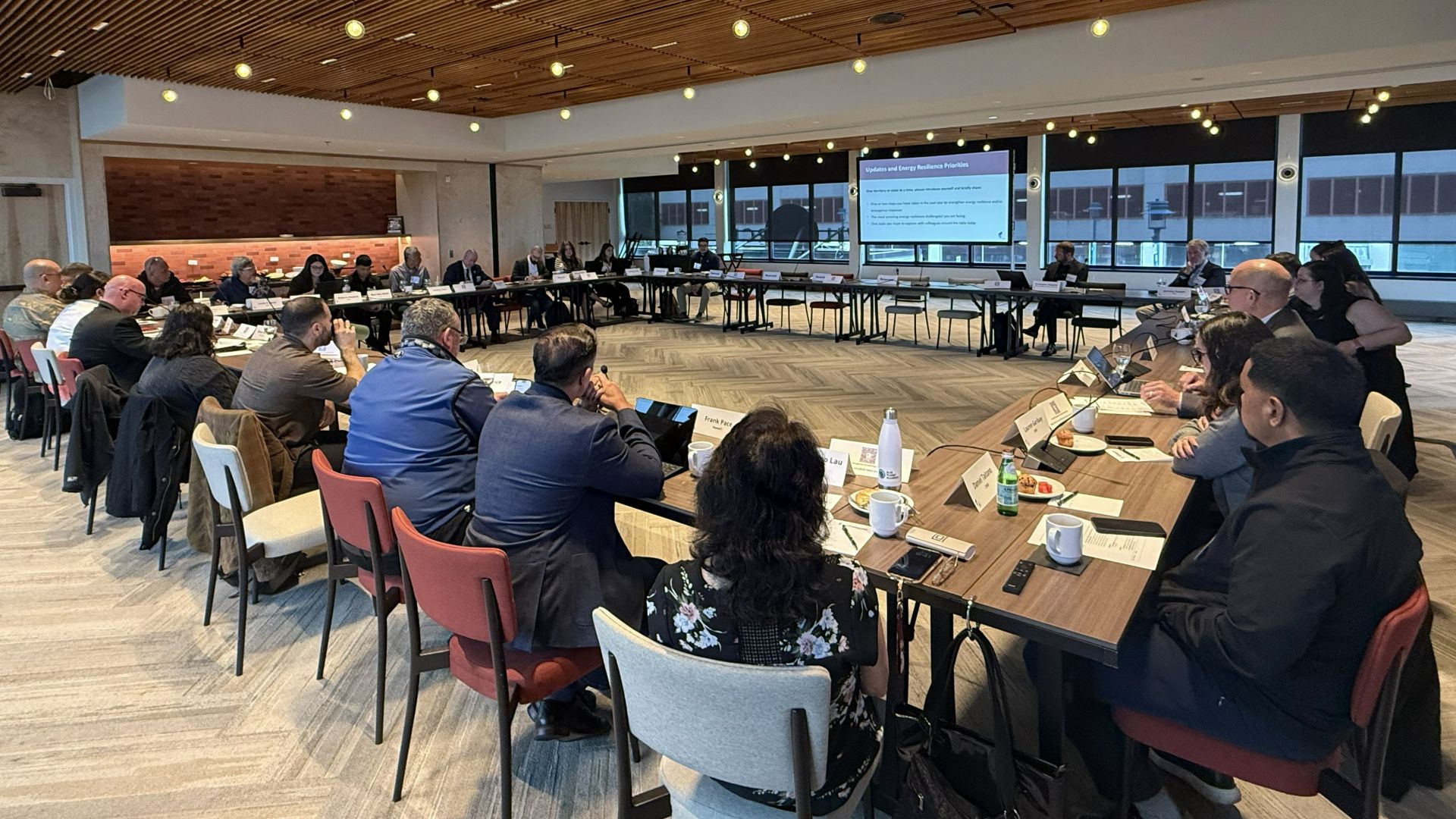
- Infrastructure Coordinator Workshops. NGA convenes governors’ infrastructure coordinators twice yearly. The 11th workshop held in May 2026 gathered more than 30 coordinators from 20 states and territories with EPA and USDOT officials to work through permitting best practices, IIJA expiration, land use alignment and public-private partnerships.
- Public-private partnerships. Public funding alone will not meet infrastructure needs under even optimistic scenarios. NGA’s State Resource Center on Innovative Infrastructure Strategies supports governors exploring P3s and asset concessions — models that remain underused in the U.S., where value comes from how private operators optimize design, operations and revenue, and where political risk is often the binding constraint.
- Broadband deployment. NGA’s annual Broadband Leaders Workshop convenes state broadband leaders on closing the digital divide, including implementation of the $42.5 billion BEAD program and the growing threat of telecommunications infrastructure vandalism to 911 systems, health care networks and other critical services.
- Infrastructure resources. NGA maintains infrastructure implementation resources and an infrastructure program page tracking governors’ priorities across roads, bridges, broadband, water, transit, rail and energy.
Frequently Asked Questions
What is the Governors Energy and Infrastructure Working Group?
It is a bipartisan group of 13 governors, co-chaired by Oklahoma Gov. Kevin Stitt and Pennsylvania Gov. Josh Shapiro, formed at NGA’s 2025 Winter Meeting to improve federal permitting and regulatory processes for critical energy infrastructure. The group spent nearly a year developing a package of reform priorities, delivered to congressional committee leaders in October 2025, on behalf of all 55 states and territories.
What reforms are governors asking Congress to enact?
The package spans five categories: streamlining federal agency reviews through shared digital systems and AI-assisted review; reforms to the National Environmental Policy Act including expanded categorical exclusions, enforceable timelines and a shorter statute of limitations for litigation; reforms to interstate energy transmission including FERC authority and RTO interconnection deadlines; reforms to nuclear energy regulation including expedited licensing for repeat designs; and reforms to the Clean Water Act strengthening state primacy and setting processing deadlines.
How is permitting reform bipartisan?
Governors of both parties face the same constraint: projects their residents need — power generation, transmission, housing, hospitals, manufacturing, roads — take years longer to approve than to build. The working group deliberately framed its recommendations as technology-neutral and apolitical, so that energy projects of all types can move forward regardless of a state’s resource mix or a given administration’s priorities. Not every working group Governor endorses every individual element; the package represents areas of common ground.
The pattern shows up in practice as well as in principle. Oklahoma modeled its permitting deadline policy on Pennsylvania’s, and at NGA’s 2026 Summer Meeting Gov. Stitt objected to federal intervention against an offshore wind project in Delaware and Maryland that was already substantially complete—arguing that no administration should reverse approvals on projects that have followed the rules, regardless of technology or which party is in the White House.
What is happening with federal permitting legislation?
The House passed the SPEED Act, focused on NEPA reforms, but progress through Congress has stalled. Permitting elements also appear in the House BUILD America 250 Act, the surface transportation reauthorization vehicle, which matters because the Infrastructure Investment and Jobs Act expires in September 2026. Governors continue to urge Congress to codify reforms in statute rather than rely on executive actions, which investors treat as fragile.
What are states doing on their own?
Pennsylvania timestamps every permit and refunds applicants when deadlines slip, moving from 48th in the nation to the top five. Delaware capped permitting timelines at six months with a unified application, instant completeness checks and a project ombudsman. New Jersey built a permitting “shot clock” so applicants can track status in real time. Oklahoma and West Virginia have enacted behind-the-meter laws letting large loads build their own generation rather than wait in interconnection queues.
How does permitting reform connect to AI and data center growth?
Rising electricity demand from computing, advanced manufacturing and electrification is what gives permitting reform its urgency. Governors are working to attract data center investment while protecting ratepayers — through approaches like Pennsylvania’s four-part test requiring projects to bring their own power, deal transparently with communities, hire locally and protect the environment. Faster, more predictable permitting is what makes it possible to add generation and transmission at the pace demand is growing.
How can a governor’s office get involved or learn more?
Governors’ offices can participate in NGA’s Governors’ Infrastructure Coordinator Network, which convenes twice yearly, and can access NGA’s infrastructure implementation resources and innovative infrastructure strategies resource center. For more information, contact the NGA Center for Best Practices infrastructure team.
Governors’ offices interested in engaging with NGA’s permitting and infrastructure work can contact Will Carraco (wcarraco@nga.org).